

On Erasure
The form, not the band (though I love the band)

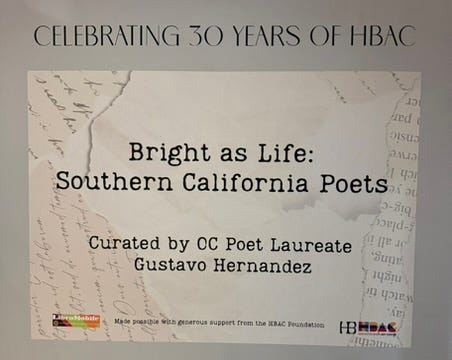
This week I was so excited to have one of my poems included in the Huntington Beach Arts Center’s show Bright As Life: Southern California Poets. The exhibit was curated by Orange County Poet Laureate and poetry dreamboat Gustavo Hernandez. It’s still a little funny to me—and a little exhilarating—to be considered a Southern California poet. I suppose I am, now more than ever, feeling like I have nourishing roots in the soil of Long Beach and a vibrant community that I cherish through the UCLA Extension Writers’ Program.
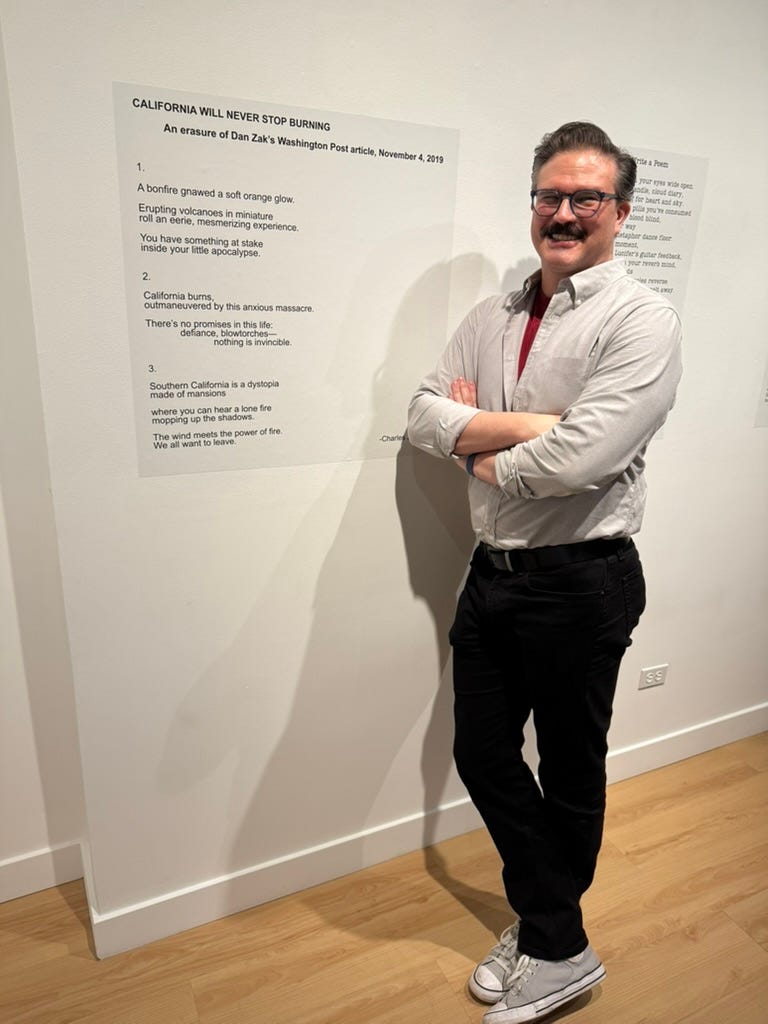
I submitted an erasure poem called “California Will Never Stop Burning,” which uses as its source text a Washington Post article of the same name by Dan Zak. That article explores the propensity for wildfire in our landscapes due to the complex intersection of geography, weather, and human settlement. As I read the original text, I sensed some degree of “people ask for this by living in a place they know catches on fire,” which is I think a common enough perspective in our era of climate catastrophe, the same attitude that looks on smugly as homes in the Outer Banks crash into the ocean, or residents of a mobile home community survey the sprinkling of their personal items tracing the path of the tornado that spirited them away. A frustration with that approach was certainly in my heart as I began the poem.
This is a poem I have a pretty vivid memory of working on—which is rare for me, because when writing onto the page, I focus on getting words down and less about what I’m doing it or how well I’m doing it. Erasures are, honestly, some of the most difficult creative work I’ve done. But I find them so rewarding and interesting and a little fun. Little puzzles I have to earn the right to see in full.
I printed the article out and grabbed a pencil. As I read, I circled words that resonated. In the early passes, I was generous. “Bonfire,” “volcanoes,” “mezmerizing,” and “apocalypse” leapt out at me. I circled them. The article is long, and I wasn’t sure how much I’d need—or want—for a poem I couldn’t even yet envision. I tried letting the vocabulary speak to me. It’s a little like a word seek puzzle, except instead of connecting letters into words, you’re trying to build phrases from words.
After a couple passes, which likely took a few days (I like to break between, thinking of that time like sniffing coffee beans when trying to decide between colognes), I started to plunk the words from the article onto a page.
A lot of times when I do erasures, I like to physically black out the words I’m not using. I did this in chapter 2 of Splice of Life, erasing part of my own story to demonstrate my changing perspective on a difficult experience I’d had. But I’ve also been working for several years on a full erasure of The Joy of Gay Sex, and that’s not really a book conducive to blacking out, in part becuase it’s….illustrated. So those poems went into a Word doc too, using this same method.
I think it took about 5 years to revise the poem to the form that hangs on the wall in Huntington Beach.
Revising erasures is tricky. You can’t just replace words. You can’t just add words. You’re limited to the words in the article, in the order they appear (per my rules, but I support you making your own rules). And I wasn’t working on this poem every day. I’d pull it out, contend with it, think about it, make some slight change, and send it out in a submission packet…where it was repeatedly rejected. Repeat.
Those rejections made me bolder in my edits. I pared away more and more words from my own poem, the same way I’d pried them out of the article, until I had something that felt as dense as it could get—meaning there was no fluff, no wasted word. Each word contributing. The poem felt more focused. More direct. And, it ended with what I thought was the coolest accidental metaphor I’d written.
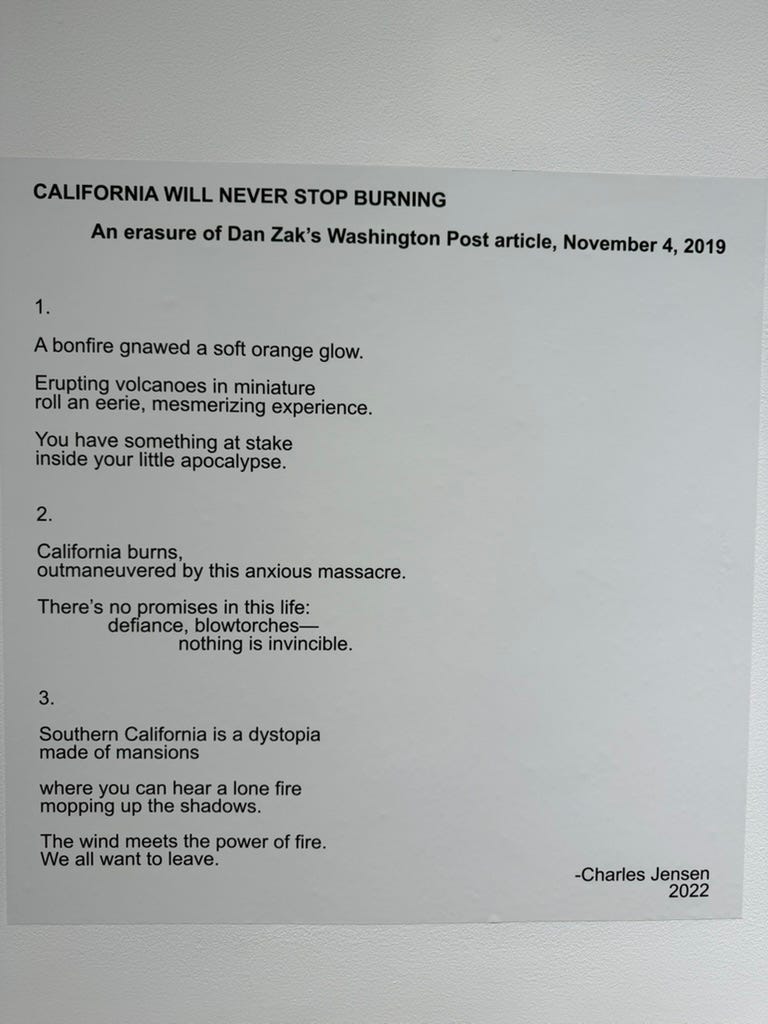
The last line lingers with me. “We all want to leave” doesn’t feel like the voice of a Californian. It feels like the theme of the article, what it was trying to convince us to believe. The voice of the poem is external to these lands, outside looking in, judging without the full context or understanding. I think that’s why this poem works for me. Often the erasure serves as a critique of its source text, and I think mine does that by making those judgements feel so overt and simplified. Is SoCal a dystopia? Not in my eyes. It’s not made of mansions either—but you might think so if you only ever saw it on television.
Erasures are laborious—I know I mentioned that but it bears repeating. They are so much work. So much work that when I sit down to do them, I wonder why I’m sitting down to do them. About 10 years ago I did a project erasing song lyrics. They never went anywhere, but I still enjoy them.
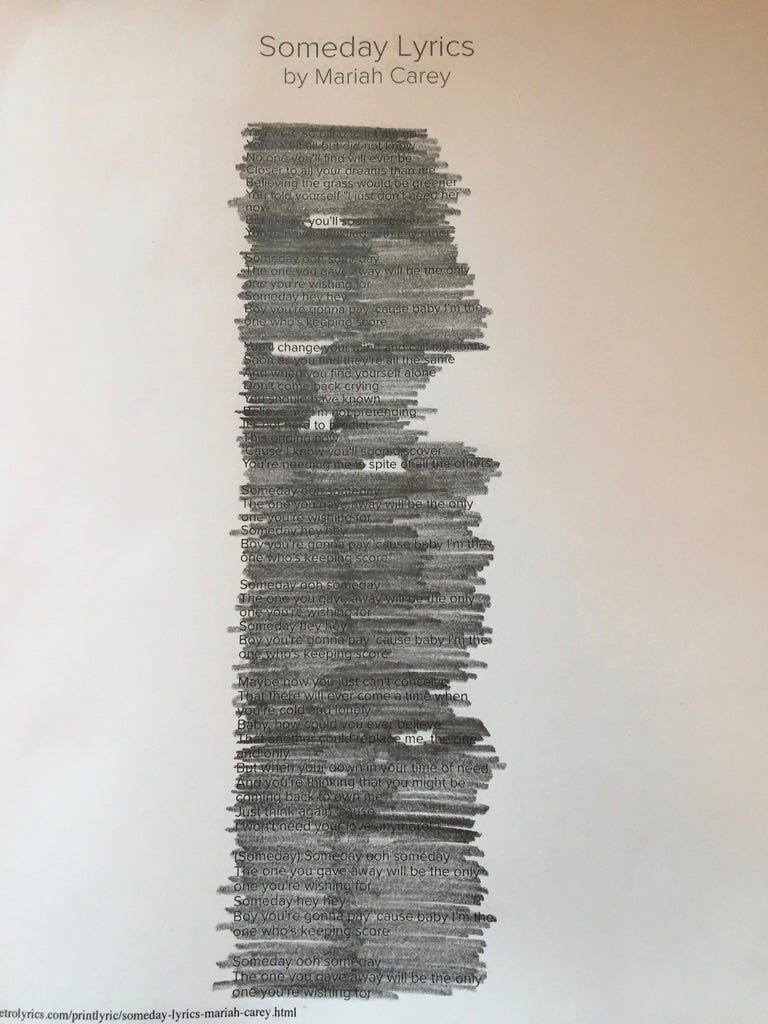
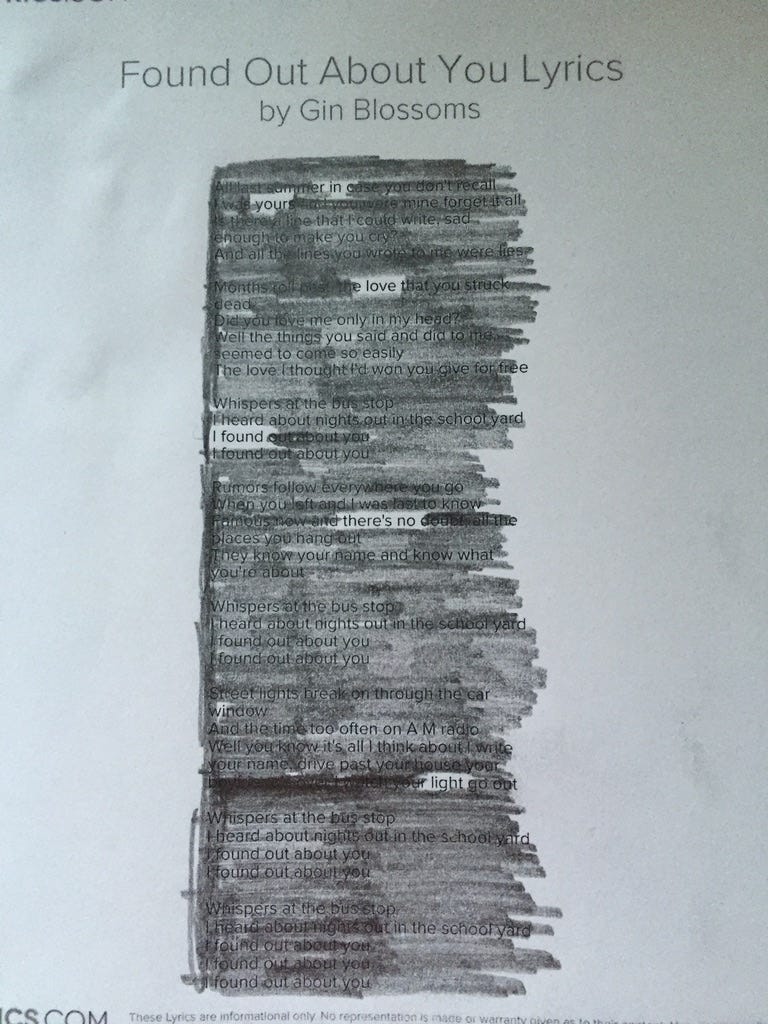
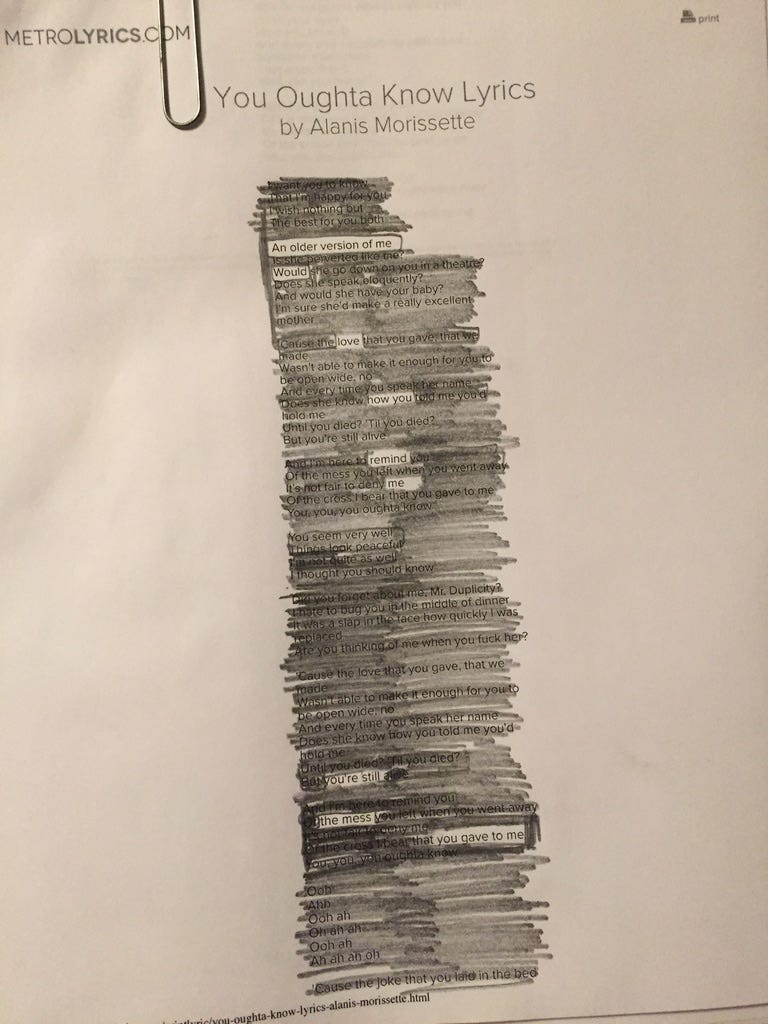
I was…going through some things, as you’ll recognize if you’ve read Chapter 11 of Splice of Life.
Sometimes in the act of defiance inherent in erasing what we don’t need, we find what to carry forward.
What a great poem. I'm always learning from you. I love this kind of poetry so much and your poem is a beautiful inspiration. Congratulations on being included in the HBAC show!
I've been wanting to tackle an erasure poem, and haven't yet. The hardest part, picking the text to erase! It feels cliche to pick a Trump speech, yet I'm drawn to that.